Wednesday, March 16, 2011

Ubuntu 11.04 Natty Narwhal Alpha 1 released

What’s new?

Being only Alpha 1 there are a lot of packages and features in heavy development, transition or out-right not included at all yet. As such don’t take too much away from this overview – a lot of things are going to change between now and April!
Unity Desktop
This is the big one. With work only starting on Desktop Unity in October it’s impressive seeing the amount of progress made in such little time.
Screenshot-5
The switch to Compiz from Mutter was certainly a good decision, not only does Unity now feel much more responsive it also looks very, very good.
The panel can also be set to auto-hide and ‘float’.
Ubuntu ‘Classic’ Desktop
If, for whatever reason, you want/need to revert to the traditional Ubuntu desktop just select ‘Ubuntu Classic Desktop’ from the session menu before logging in.
Sound menu changes
The Ubuntu Sound Menu has had a few minor changes already including new player control buttons and an ‘indented’ cover art frame.

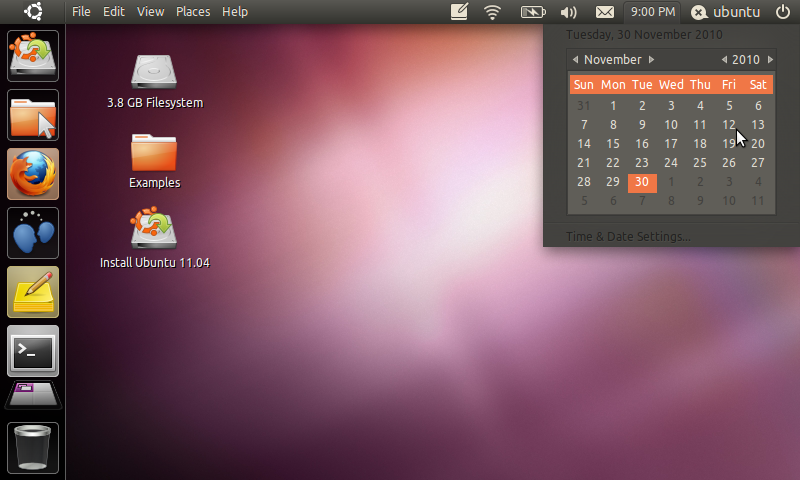
Indicator-datetime is back
My favourite indicator is back – Indicator-Datetime! I’ve absolutely no logical/sane reason as to why I love it so much but it’s there, rocking out with its calendar widget…
Screenshot-4
Panel applets
I suppose the biggest change most users would recoil in horror at when using the Alpha is the redaction of traditional panel applets; applications using the old system tray are now at a loss.
Which means that…
Network Manager
The Network Manager applet now wears ‘indicator’ clothes. It feels feeble to say that this makes a huge difference to the way the desktop ‘feels’ but it really does.
Screenshot-2

Obligatory Video of Alpha 1 in action

Download

If you’re feeling brave you can grab Natty Alpha 1 – as well as see a comfortingly long list of known issues – @ ubuntu.com/testing/natty/alpha1

The end of Ubuntu Netbook edition

Canonical has announced that ‘Ubuntu Netbook Edition’ – the netbook-orientated version of the Ubuntu operating system – will be ‘folded’ into ‘Ubuntu Desktop Edition’ for Ubuntu 11.04, with the latter being rebranded simple as ‘Ubuntu’.
Canonical marketing manager Gerry Carr writes: -
“From 11.04 the core product that you run on your PC will be simply, Ubuntu. Therefore the next release will be Ubuntu 11.04 and you can run that, my friend, on anything you like from a netbook to a notebook to a desktop. “


So why the move?

Unlike previous editions of the operating system Ubuntu 11.04 comes with Unity as the default desktop ‘shell’. As Unity was created, originally, for Ubuntu Netbook Edition, but now adapted for use as a desktop interface, Ubuntu 11.04 is able to work just as well on a netbook screen as on a desktop.
‘Two birds, one stone’ and all that.
Carr highlights that the move should certainly not been seen as  a ‘withdrawal’ from catering towards netbook users, saying that the move is the result of Canonical ‘recognising that the market has moved on’ and that ‘separate images are no longer a requirement as the much anticipated convergence of devices moves closer. “
The move does not affect Ubuntu Server Edition.

What is Android?

Developed by the Open Handset Alliance, Android brings Internet-style innovation and openness to mobile phones.
Android™ delivers a complete set of software for mobile devices: an operating system, middleware and key mobile applications. The Android Software Development Kit (SDK) is now available.

Open

Android was built from the ground-up to enable developers to create compelling mobile applications that take full advantage of all a handset has to offer. It was built to be truly open. For example, an application can call upon any of the phone's core functionality such as making calls, sending text messages, or using the camera, allowing developers to create richer and more cohesive experiences for users. Android is built on the open Linux Kernel. Furthermore, it utilizes a custom virtual machine that was designed to optimize memory and hardware resources in a mobile environment. Android is open source; it can be liberally extended to incorporate new cutting edge technologies as they emerge. The platform will continue to evolve as the developer community works together to build innovative mobile applications.

All applications are created equal

Android does not differentiate between the phone's core applications and third-party applications. They can all be built to have equal access to a phone's capabilities providing users with a broad spectrum of applications and services. With devices built on the Android Platform, users are able to fully tailor the phone to their interests. They can swap out the phone's homescreen, the style of the dialer, or any of the applications. They can even instruct their phones to use their favorite photo viewing application to handle the viewing of all photos.

Breaking down application boundaries

Android breaks down the barriers to building new and innovative applications. For example, a developer can combine information from the web with data on an individual's mobile phone -- such as the user's contacts, calendar, or geographic location -- to provide a more relevant user experience. With Android, a developer can build an application that enables users to view the location of their friends and be alerted when they are in the vicinity giving them a chance to connect.

Fast & easy application development

Android provides access to a wide range of useful libraries and tools that can be used to build rich applications. For example, Android enables developers to obtain the location of the device, and allows devices to communicate with one another enabling rich peer-to-peer social applications. In addition, Android includes a full set of tools that have been built from the ground up alongside the platform providing developers with high productivity and deep insight into their applications.

Sunday, February 20, 2011

Groklaw: How One Person Can Do Big Deeds

The endless SCO saga is finally at an end, and justice has prevailed. But without Groklaw, would it have ended differently? Let me rephrase that: it will probably continue to sputter and emit random gases, because the nice SCO leadership and their backers are masters of weaving grand propositions out of fantasy, and perpetuating their fantasies in the seemingly non-functional US civil courts system. But for all non-Bizarro world purposes it is over. The SCO vs. Novell verdict settles the key question of who owns the Unix copyrights. Answer: not SCO. I know, it's a little more complex than that because there are several Unix variants. But as far as SCO's silly claims against Linux, it is definitively over.
Those of us who followed this loony saga from the beginning are wondering: What would have happened if Pamela Jones and Groklaw had not taken an interest in this case? Would there have been any semblance of truth anywhere? I think not.
Cast your minds back to the beginning in 2003, when Groklaw was a few months old, and had moved from Radio UserLand to its current home on Ibiblio.org. Darl McBride was shooting off his mouth to anyone who would listen, spouting the craziest nonsense. The SCO Group were making novel claims like IBM was devaluing their business by stealing SCO's Unix code and infiltrating it into Linux, which transformed Linux from an inferior hobbyist's toy into an enterprise powerhouse that stole SCO's business. It was unusually entertaining for business litigation: this unknown pipsqueak taking on Big Blue, a crazy braggart CEO who was always good for fun sound bites, the SCO Information Minister Blake Stowell emitting equally nonsensical comments with a straight face, and escalating legal claims against AutoZone, DaimlerChrysler, and Novell. When media interest waned he re-gained center stage with stunts like hiring celebrity loser lawyer David Boies, and claiming that crazy Linux fanatics threatened his life so he had to hire a bodyguard.
Fueling the fun was both the mainstream and tech press dutifully reporting all of it, without bothering to question any of CEO McBride's claims or do any independent investigation. And then there were the fine "independent" industry "analysts" and "reporters" (yes, my fine readers, those quote marks indicate sarcasm) like Laura DiDio of the Yankee Group, Dan Lyons of Forbes magazine, and Rob Enderle and Maureen O'Gara of anyone who would publish them, who wrote thousands of words solemnly assuring their readers that SCO's claims were solid, and boy were those unwashed Linux hippies going to be sorry they stole all that stuff from SCO.
The deck was completely stacked against any kind of real reporting from the beginning. Would this have mattered in the courtroom? After all, SCO was taking on companies many times larger, and who had the deep pockets to fund all the legal firepower they needed. So I can't say what effect Groklaw might have had in the courtroom, if any.
But Groklaw had a huge effect on getting the truth out, informing and energizing people who were following the case. PJ dug through the mounds of manure and obfuscation and uncovered what was really going on. She analyzed and posted reams of court filings, challenged Darl's ridiculous claims (which should have aroused skepticism in anyone with an ounce of sense), and inspired hordes of volunteers to attend court sessions, transcribe grotty PDF transcripts, and do additional research. She preserved archives of SCO's own online documents which later disappeared, or were changed. She also inspired a number of journalists to go beyond the sound bites and do some digging of their own. Groklaw awakened an interest in the law in a lot of its followers, and gave a fascinating inside look into how the law works.
She did all this despite ongoing harassment and threats. That takes bravery, and not many people would have persisted. Thank you PJ, what you have achieved with Groklaw is a very big deal. We owe you a lot.

HTML5 will henceforth be known as just HTML

HTML5 is the next major version of HTML and is widely considered future of the Web. In particular, HTML5 adds many new syntax features. These include <video>, <audio> and <canvas> elements as well as integration of SVG content, which are designed to improve the inclusion and handling of multimedia and graphic content on the web without recourse to proprietary plugins and their APIs [Source : Wikipedia].

The Web Hypertext Application Technology Working Group (WHATWG) is a community founded by individuals of Apple, the Mozilla Foundation, and Opera Software in 2004. It's main focus is the development of HTML standard and APIs needed for Web applications.

In a blog post, WHATWG has announced that HTML5 is going to lose its version number. HTML5 can now be considered as a "living standard", and will henceforth be known as HTML, with the URL http://whatwg.org/html.

On an unrelated note, W3C unveiled a new HTML5 logo to help the developers and website builders promote the HTML5 standard by letting the world know that they are using HTML5.


HTML5 Logo
If you are wondering, the HTML5 logo (shown above) signifies "a coat of arms and badge of honor".

They are also selling T-shirts,and mugs and a part of the proceeds will support the HTML5 test suite effort.

HTML5 Sticker

Here is what the W3C blog had to say about the purpose of this logo (and I quote).

We intend for it to be an all-purpose banner for HTML5, CSS, SVG, WOFF, and other technologies that constitute an open web platform. The logo does not have a specific meaning; it is not meant to imply conformance or validity, for example. The logo represents "the Web platform" in a very general sense.

The logo is available under a permissive license (Creative Commons 3.0 By) so that you can make it fit into your own designs.

Is Nokia Committing Harakiri By Aligning With Microsoft ?

Nokia Cell Phones
The big news today - as far as cellular world should be concerned, is the strategic partnership between Nokia and Microsoft to produce smart phones running Windows 7. Nokia says it will adopt Windows Phone as its primary smart phone strategy. Meaning, Symbian OS is going to be relegated to history. And MeeGo project on Nokia smart phones would be in limbo.


Thinking back, my first cell phone was a Nokia. At that time, Nokia was a dominant player in the Indian cell phone market. However, in the years that followed, Samsung and many other players have succeeded in grabbing a share of the pie (obviously at Nokia's expense).

So much so that, in India at present, if you go to any mobile shop to buy a cell phone, chances are you will be deluged with Samsung devices and not Nokia's. Currently, even I use a Samsung cell phone (though not a smart one). Verily Samsung offers more variety to its customers than Nokia ever has.

In the future, it is a given that mobile devices are going to permeate our lives even more. And smart phones are going to replace their dumb counterparts. Be that as it may, one of the best ways for Nokia to reclaim its market share is through innovation - by rolling out smart phones powered by its own homegrown OS. MeeGo, which is being developed on a Linux kernel shows a lot of promise. For one, there won't be a dearth of applications on MeeGo as most applications that run on Linux will run on MeeGo as well.

Sleeping with Microsoft is not going to turn Nokia's fortunes for the better any more than if it were to embrace an open source OS to power its smart phones.

For instance,
  • Windows OS is closed source and proprietary.
  • It entails paying a royalty to Microsoft. And that additional cost will be transferred to the customer. 
  • Nokia will be subjugated to play a lesser role in the smart phone arena - the terms being dictated by Microsoft.
  • And Nokia risks alienating its customers who might move to embrace products from its competitors which are powered by an open source OS.

Not surprisingly, this official announcement by Nokia and Microsoft has invited widespread criticism as indicated by over 460 comments made there.

On a personal level, I was looking forward to buying a MeeGo powered Nokia cell phone when it was released. I guess my wait is going to be futile.

Monday, February 14, 2011

Microsoft releases near-final Internet Explorer 9 version

IE9 is a free download that works Windows Vista and Windows 7 computers. It's not compatible with Windows XP.
With , followed the visual lead of Google Inc.'s Chrome browser. IE9 has far fewer buttons, icons and toolbars filling the screen, leaving more room for the contents of Web pages. It mimics some features in Windows 7, the newest PC from Microsoft, in that it lets people "pin" individual websites to the taskbar at the bottom of the PC screen to make permanent one-click shortcuts.
Based on feedback from the , which Microsoft said was used by 25 million people, the software will let people add a new row of tabs to the bar at the top of the browser window. It will also pop up fewer notifications.
The new browser is much more than an aesthetic overhaul. IE9 can take advantage of multicore microprocessors to crunch website code faster. It also uses the PC's - the same chips that make the images in elaborate video games run smoothly - to make movie clips and other visuals load and play faster.
Microsoft said Thursday that it has improved several aspects of the browser that make it run faster than the beta that was released in September. It fine-tuned the engine for rendering JavaScript, a widely used Web programming language, so pages load faster. IE9 now also decides on the fly when to tap into the graphics processor for more speed.
Competitors including Google and Mozilla, maker of the Firefox browser, are also working on similar technical upgrades to their software. This new crop of browsers will be competing with "apps," small programs for smart phones, tablets and other devices that deliver the some of the same content as websites but in a way that's easier to navigate on smaller screens.

EBay PayPals it forward

eBay's renaissance can be summed up in one word: PayPal. Since late October, shares are up more than 33%. That includes an 8% pop Thursday after executives gushed to analysts about the growth potential for its payment unit. Shares hit a more than 3-year high on Thursday.
Chief executive officer John Donahoe boasted to analysts that revenue from PayPal could more than double from last year's totals to as much as $7 billion annually by 2013. If that happens, PayPal's sales could soon eclipse the revenue that eBay's bread-and-butter auction sites generate.
But is it really possible that PayPal will pass the core eBay (EBAY, Fortune 500) business that quickly? Analysts seem to believe so. International expansion as well as the increased adoption of PayPal on smartphones could help.
In a report Friday morning, Jefferies & Co. analyst Youssef Squali referred to eBay's PayPal goals as "ambitious but not unrealistic."
Marianne Wolk, an analyst with Susquehanna Financial, added in a research note Friday that she believes PayPal will account for about 45% of eBay's profits within two years. That's up from about 30% now.
Investors are taking notice too. Eric Jackson, managing member at Naples, Fla.-based hedge fund Ironfire Capital and quite possibly the best source for hilarious commentary about breaking tech news on Twitter, tweeted Thursday that it's 'only a matter of time until $EBAY changes its ticker to $PYPL."
Jackson later referred to Donahoe's analyst day remarks as his "I'm no Meg Whitman speech," referring to the former eBay CEO and failed California gubernatorial candidate.
It's a spot-on point. While Whitman obviously did a fantastic job at eBay for much of her tenure there -- she was CEO way back when it went public in 1998 and deserves a huge amount of credit for the company's success -- her reputation took a bit of a hit for overpaying for Internet phone service Skype in 2005.
EBay subsequently dumped Skype for less than what it bought it for and Skype is now preparing (although it's taking its sweet time) for an IPO of its own. Since the Skype sale though, eBay has been a far more focused company.
PayPal always made logical sense as something that meshed well with the auction side of eBay. Now it's proving to be not just a great complimentary service for eBay users but a legitimate standalone business in its own right.
Of course, the big question for investors is whether this is already factored into eBay's stock price.
Shares trade for nearly 18 times 2011 earnings estimates. That's not absurdly high, especially when you look at Amazon.com's valuation. Of course, Amazon (AMZN, Fortune 500) and eBay are not exactly true peers. But for what it's worth, Amazon trades at a stunning 58 times 2011 earnings forecasts.
Still, some think eBay may not have much room to climb. It's valuation may actually seem a bit frothy when you consider that analysts only expect total profits to increase by about 11% this year and in 2012.
ThinkEquity analyst Aaron Kessler wrote in a report Friday morning that eBay looks fairly valued because he thinks the earnings for the core marketplace business are only going to grow by about 5% to 10% annually over the next few years.
Kessler's target price for eBay is $35. Shares closed on Thursday at $34.49.
But others argue that earnings estimates are likely to be revised higher given the company's confidence about PayPal. Caris & Co. analyst Sandeep Aggarwal wrote in a report Friday that current consensus estimates for earnings are still probably too low.
And Josh West, an analyst with Kornitzer Capital in Kansas City, said that investors may be underestimating some of eBay's efforts to bolster its presence in growing parts of the marketplace business, such as fashion and electronics. EBay is one of the top holdings in the firm's Buffalo Large Cap fund.
"PayPal is doing even better than most people thought it was and eBay still has this great network effect of buyers and sellers," West said. "There is upside to this stock. We're in no hurry to sell."
Another fund manager said it looks like the company may also have finally overcome some of the problems that plagued the company after some controversial fee hikes a few years ago.
"It hadn't been a favorite stock of many institutional investors for a while. People were concerned about them losing market share after the fee changes," said Bob Bacarella, manager of the Monetta Young Investor fund in Chicago.
"But people are finally recognizing the value in PayPal. I wish I owned more of the stock," he added, saying that he's both an investor and an active eBay and PayPal user.
Reader comment of the week. The news biz got all worked up in a frenzy over AOL's deal to buy The Huffington Post on Monday and how it would or would not transform the media world. That prompted me to remind people over on Twitter about how investors still mostly view AOL as irrelevant.
I pointed out that AOL's (AOL) stock was down 11% so far this year while Walt Disney's (DIS, Fortune 500) shares were up 11%, adding that "if this is new media, I'd rather be old media."
Now I'll be the first to admit that I'm obviously biased given that I work for Time Warner (TWX, Fortune 500) -- which is not only one of those old media conglomerates but the one that suffered mightily after it merged with AOL.
But leave it to Josh Brown, aka the amazingly talented @ReformedBroker, to point out why the "old vs. new" distinction is sooooo 1997. "There is no New Media or Old Media anymore, only Good Media or Bad Media." Well said.

Groupon explains Super Bowl ads, highlights giving

In three spots that ran before, during and after Sunday's game, commercials that appeared to promote humanitarian and environmental causes -- most notably Chinese government oppression in Tibet -- swerved to become tongue-in-cheek pitches for Groupon deals.
Critics, many of whom took to Facebook and Twitter to complain, said the ads, directed by actor-director Christopher Guest of "This is Spinal Tap" and "Best In Show" fame, made light of serious situations.
"We would never have run these ads if we thought they trivialized the causes -- even if we didn't take them as seriously as we do, what type of company would go out of their way to be so antagonistic?" Mason wrote on Groupon's official blog.
In the Tibet ad, actor Timothy Hutton bemoans the human-rights situation in Tibet before quipping from a Tibetan restaurant, "But they still whip up an amazing fish curry!"
In the two others, actor Cuba Gooding Jr. bemoans the world's dwindling number of whales before talking up a discounted whale-watching cruise and actress Elizabeth Hurley bemoans imperiled Amazon rainforests before promoting a deal on a Brazilian wax (adding that "not all deforestation is bad").
Any backlash against the ads didn't appear to have any immediate impact on the popularity of Groupon's iPhone app, which was the third-most popular free application Tuesday morning in Apple's App Store.
Mason notes that Groupon began as The Point, an activism-based site, and that the Web page for the Groupon ads offers a link to donate to each of the causes that the ads spoof. "We took this approach knowing that, if anything, they would bring more funding and support to the highlighted causes," he wrote.
Groupon is matching the amount its customers donate to the causes, up to $100,000 each.
In a blog post, Greenpeace biologist John Hocevar (who also, coincidentally, founded Students for a Free Tibet), praised the ads.
"Greenpeace is happily participating in the campaign," he wrote. "The truth is that the 'Save the Money' campaign and the commercial are really helping us save the whales."
Mason said that, rather than making fun of charitable causes, the ads were intended to make light of Groupon itself, and advertising in general.
"Our ads highlight the often trivial nature of stuff on Groupon when juxtaposed against bigger world issues ... ," he wrote.
He also took a somewhat defensive potshot at other Super Bowl ads.
"When we think about commercials that offend us, we think of those that glorify antisocial behavior -- like the scores of Super Bowl ads that are built around the crass objectification of women," Mason said. "Unlike those ads, no one walks away from our commercials taking the causes we highlighted less seriously.
"Not a single person watched our ad and concluded that it's cool to kill whales. In fact -- and this is part of the reason we ran them -- they have the opposite effect."
Mason never apologizes directly in the post, but says "the last thing we wanted was to offend our customers."
Based on comments posted on the blog, some Groupon customers were satisfied with the explanation -- but not all.
"I do actually appreciate knowing the backstory here. I agree that the idea isn't exactly horrible, especially as you've laid it out," one reader wrote. "But the finished, as-aired Tibet commercial was horrible. It did trivialize the cause. That you didn't mean to be offensive doesn't mean you weren't."

Facebook app tells college applicants what their chances are

Startup Splash Networks wants to make selecting schools to send an application to easier.
On Tuesday, the company is launching a Facebook app called AdmissionSplash that shows prospective college students how likely it is that they will be admitted to each school on their lists.
The app asks students for their basic information: test scores, address, and other factors that affect admissions, like whether they volunteer or play sports. It then uses an algorithm to give users a desirability rating as well as the likelihood, ranging from "very poor" to "very good," of getting into the schools.
Admission Splash currently runs customized equations for about 1,500 schools that it developed using the admission data they release.
Admissions offices often paint a picture of case-by-case application analysis that can't be narrowed down to an equation.
"Although high school grade point average and standardized test scores are important indicators of academic achievement used in UCLA's admissions review, they only tell part of the story," advertises UCLA's prospective student website, for instance.
But AdmissionSplash's equation, which definitely doesn't take essays into account, has been pretty accurate in tests that use publicly available admissions profiles.
In the case of UCLA, approximately 85% of students the app said would get admitted actually did.
The sample sizes of these tests are fairly small (73 people for the UCLA test), so I wouldn't suggest posting AdmissionSplash results on one's Facebook page before getting an acceptance letter.
Using the tool as a way to compare schools' competitiveness or to share a list of prospective schools with friends, on the other hand, seems like a win.

Solving your digital Valentine's Day dilemmas

That's why this week, before that most sugar-spun monstrosities of commercial holidays, we've chosen to go all "Dear Abby" on you, picking three digital love-themed questions from our swooning readers to aim at like fat little Cupid with his bow.
No such thing as "Just Facebook Friends"
So this girl breaks up with me a week after telling me she was falling in love with me (classy). She has a thing with another guy now (still classy), but she "still wants to be friends."
I can't stand seeing her name pop up on my Facebook feed, and oftentimes, I will find myself creepin' on her profile (Yes, yes, I know. Classy). Needless to say, I'm sick of it. But I said I would try to remain friends, and I feel the need to keep my word, because unlike her, I don't lie. Do I delete her as a friend?
-- Miserable in Minnesota
Sorry to tell you this, Miserable, but this chick doesn't really want to be friends. She wants to have the digital reassurance -- right there in pixels and pings -- that you forgive her for lying to you and (it sounds like) cheating on you.
By keeping you as a Facebook friend, it's like telling the world and herself: "Hey, look, we're cool! We're friends! Facebook says so!" However, what serves as a Band-Aid to her is more of a festering wound to you.
A recent survey from lifestyle site YourTango.com shows that 48% of people look at their ex's social-networking profiles too often, a stat that led to the site instituting "Break Up With Your Ex Day," a call to cut your former swain out of your social networking life. We suggest you join the party.
Yeah, it's fine to be Fakebook friends with random classmates from high school, but an ex who tears out your heart and forces you to look at it, stomped-on and scar-tissued, every day in a dedicated newsfeed? Rip that Band-Aid off, my friend. It may hurt initially, but eventually that wound will heal faster.
Defining the relationship (status) talk
I've been dating this guy for six months, and we're an official "couple," but it's not on Facebook. We'd initially established that it wasn't important, but now I kind of want that "In Relationship With" thing (cause dude's hot and I want my friends to be jealous, obviously). How the hell do I go about this? Just come at him with a relationship request? Get drunk on cheap Pinot Noir and tell him?
-- Impatient in Illinois
The last one! The last one! And save some P'Noir for us. No, seriously ...
We're usually not down with the whole "virtual ties that bind"-ness of Facebook relationship statuses (changing one's Facebook status to "single" following a breakup is basically like flashing everyone you know -- it's embarrassing and everyone will want you to explain why you did it). But we understand the need to show-pony your dude around in front of your various and sundry "friends," especially those aforementioned randos from high school.
So here's the deal: If you're comfortable enough with the guy to introduce him to real life people as your "boyfriend," it shouldn't be a big deal if you ask him to make it known online. Just tell him what you told us: "You're hot, and I want to show you off." Flattery will get you everywhere.
To text or not to text?
I've been seeing this dude for three weeks now and we've gone on a few pretty good dates. We chat a little between hangouts -- mostly texts, GChats and Facebook comments -- but it's definitely not serious (at least not yet).
My question is: Do I have to tell him "Happy Valentine's Day" in some way? I mean, I know that sending him a pink teddy bear that says "I love you" and making reservations at a swank restaurant is insane, but would it be weird to text him or something?
-- Tentative in Texas
What? Everyone loves presents! Send him the bear, make the reservations and e-mail him a link to Thoughtful, a startup that helps men choose gifts for women, so he won't buy you something stupid. Annnnnd we're kidding. That would be horrifying.
This is indeed a tough question -- if it were Christmas, Thanksgiving or any other unsexy holiday, we would say go for it, but sending someone a message on a day that (rather inanely) revolves around love is tricky.
You say the dude contacts you between dates? We would say take the temp of said messages and go from there. Are they along the lines of, "Your lips are like two luscious cherries, your skin akin to a sea of milky whipped cream topping the sundae that is your perfect form"? Well, then, sure, this bro isn't going to be turned off by a simple text message, although you might want to start running for the proverbial hills.
If your guy is more of a "Hey! Check out this super-slowed-down video of some horrifying child singing gibberish" kind of man, you might want to skip the sugar and converse as you normally would -- but maybe send him an especially hilarious "baby-lion-licking-a-dude" video to let him know you care.

Smartphones have conquered PCs

Over the past two years, smartphone shipments have tripled, while PC shipments grew a comparatively measly 45%.
Of course, comparing smartphones to PCs isn't exactly fair. Americans, which make up the largest chunk of the smartphone market, tend to buy new devices every two years after their wireless contracts expire. PCs not only last longer, they are also more expensive.
There's also the issue of saturation: Though there's room for growth in much of the world, 80% of Americans own a PC, compared to just 17% who own smartphones, according to Forrester Research.
But the trend is also indicative of a sea change in the kinds of devices people are using for their everyday computing needs.
Smartphones now come with multi-core microchips and are getting closer to matching the processor speeds of some PCs. But they also do a whole lot more: Smartphones have cameras, 3G connectivity, the ability to download apps and Web content from anywhere, and access to location-based services through GPS.
The devices have just one user, so they are intimately personalized. And since they follow their users around all day, they can handle tasks like monitoring your health or starting the engine of your car.
Smartphones have become cheaper, more functional and offer more bang for the buck than PCs. That's helped the developing world become the fastest-growing smartphone market. Amazingly, there are 48 million people in the world who have mobile phones, even though they do not have electricity at home, according to Cisco (CSCO, Fortune 500).
The trend is taking hold at home too: Smartphone penetration in the United States is expected to match that of PCs by 2015, Frost & Sullivan forecasts. By 2013, more people in the world will access the Internet on a mobile device than on a PC, research firm Gartner expects.
Some doubt that PCs will ever completely disappear (who wants to do productive tasks like word processing on a mobile phone?). Others argue that PCs aren't going away, they're just taking on a new form: Some consider the 18 million tablet sales in 2010 to be PC sales, since the devices are more PC-like than smartphones. Of course, others maintain that tablets are just smartphones with a bigger screen.
Regardless, envisioning a world without traditional PCs seems less far-fetched every time a new innovation in the smartphone space unveils a previously unheard-of use for the mobile devices.
For instance, Motorola's (MMI) new Atrix 4G smartphone, which will be sold on AT&T's (T, Fortune 500) network in early March, has the ability to become a quasi-PC. The smartphone can be purchased alongside a separate screen and keyboard, which are powered by the phone. When the phone is inserted into the dock, the screen and keyboard come to life, and possess the computing capabilities of a low-end netbook.
Imagine what smartphones will be able to do just a few years. Perhaps we'll all be plugging them into docks at work, using them for business applications and productivity, taking them with us on the road, and plugging them back into our home docks

Cisco's profit falls 18%, but still beats estimates

Still, a cautious outlook sent shares of Cisco (CSCO, Fortune 500) down 13% Thursday.
On a conference call with analysts, Cisco CEO John Chambers said that Cisco expects its revenue to grow by just 4% to 6% in the current quarter compared to last year. That's right in line with Wall Street's estimate of 5%, according to a survey of analysts polled by Thomson Reuters.
Chambers said he expects sales to pick up soon, with revenue growth of between 8% and 11% next quarter, though that's lower than the 9% to 12% guidance he gave in the previous quarter.
Cisco's CEO gave tepid guidance during the previous quarter's conference call in November. Since then, shares have fallen 17%, though they continued to make a steady comeback until Wednesday afternoon.
The company has struggled as sales to the public sector and governments have slowed. Cisco has also found new rivals entering the networking scene, like Hewlett-Packard (HPQ, Fortune 500) and IBM (IBM, Fortune 500), which have added new services to help them become one-stop shops for technology customers.
Chambers said Cisco has found that its new competitors are adding to pricing pressure.
To keep up, Cisco is transitioning from the world's largest networking provider to a broader-based IT supplier, adding new consumer products to its lineup.
The company's services unit is now 21% of its business, and sales in that unit grew 18% last quarter.
But legacy businesses like routing and switching still make up 46% of the company's revenues. Routing revenue was up just 4% and switching sales fell 7% in the quarter.
"As a company, we are going through a period of transition as we move aggressively in the market with our architectural strategy," Chambers said on the call. "As I look back on this period, I wish we could have avoided it, and yet it will make us stronger in time. We have managed these market transitions many times, positioning Cisco and our customers for success."
By the numbers
During the past quarter, the San Jose, Calif., company said its net income fell to $1.5 billion, down 18% from a year earlier.
The results of Cisco's fiscal second quarter, ended January 31, included one-time charges of 10 cents per share. Without the charges, Cisco earned 37 cents per share. Analysts polled by Thomson Reuters, who typically exclude one-time items from their estimates, had forecast earnings of 35 cents per share.
Sales rose 6% to $10.4 billion, topping analysts' forecasts of $10.2 billion.
Cisco also continued to stockpile cash, increasing its hoard to $40.2 billion, up from $39.9 billion in the previous quarter. The company announced late last year that it will begin to pay a dividend yielding between 1% and 2% in the current fiscal year, which ends in July

Apple iPad 2 now in production

The fact that Apple is working on an iPad 2, of course, is common knowledge. The famously tight-lipped company rarely talks about upcoming product launches, and isn't talking now. But Apple has never denied that it intends to follow up on one of its most successful products.
Nearly $5 billion worth of iPads have been sold in the three quarters since its launch. And a quick glance at the history of the iPhone, which launches a new model every year, suggests that we should expect to see the iPad 2 right around the first anniversary of its predecessor's launch: April 3, 2011.
A prototype of the iPad 2 was apparently spotted by a Reuters reporter after the launch of News Corp's iPad publication, the Daily, last week. And an unconfirmed report from DigiTimes in December said that Foxconn, the Chinese makers of the iPhone and iPad, had been ordered to manufacture the iPad 2 in market-ready quantities by the end of February.
The Journal report, which carries three bylines and cites "people familiar with the matter," offers a few more nuggets of detail. It confirms the widely-held belief that the iPad 2 will have a front-facing camera, enabling use of the Facetime videoconferencing app.

It says that the 3G version will again be available on Verizon and AT&T, with Sprint and T-Mobile still shut out. But it contradicts earlier reports that Apple will endow the iPad 2 with a higher-resolution screen, much as the iPhone 4 had significantly higher resolution than the iPhone 3GS. Apple is likely still working on a higher quality iPad display -- it just won't be ready for the iPad 2.
So will a slightly improved Apple tablet with camera be enough to persuade millions of iPad users to upgrade? Are there other bells and whistles we don't know about yet? We have previously reported on rumors that the new device will have an SD Card slot, and that it will feature rear-facing and front-facing cameras. (Click here for our comprehensive roundup of iPad 2 rumors).
We'll know when Apple's acting CEO Tim Cook takes the stage, if this product timeline is accurate, in a few months' time.

HP unveils TouchPad tablet

palm_touchpad.top.jpg
The TouchPad comes with an iPad-like 9.7-inch screen, a front-facing camera and weighs 1.6 lbs. It can multitask and sync with other HP devices like smartphones and printers, and it can display Web content encoded with Abobe Flash (something iPads won't do).
Unique features of the TouchPad include a resizeable keyboard and the high-quality "Beats" audio speakers that HP features on many of its laptops.
Slated for release this summer, the Wi-Fi-only version of the TouchPad will be unveiled first, with the 3G and 4G versions hitting the market at a later date.
HP's new smartphones included the Veer, a credit-card sized smartphone with a pull-out keyboard, and its slightly larger cousin, the Palm Pre 3.
HP left out one key detail about the TouchPad: Its price tag. The company plans to announce pricing later.
The devices are the first fruits of HP's $1.2 billion white knight purchase of Palm 10 months ago.
Palm went "all-in" with its then-new webOS operating system when it debuted the Palm Pre in January 2009. Despite rave reviews of the webOS platform, the Pre and its smaller sister, the Pixi, never quite caught on with consumers.
After buying Palm, HP opted to scale up webOS, saying it would eventually become a platform that goes beyond just smartphones. HP will also unveil webOS printers and PCs later on, the company said.
The OS has failed so far to attract application developers, but HP announced several new high-profile app partners, including Amazon's Kindle app, Facebook and Fortune parent company Time Inc.
In a direct shot at Apple (AAPL, Fortune 500), HP and Time Inc. plan to make some of Time Inc.'s magazines available for sale under a subscription model. The iPad only currently allows a subscription service for one content provider: News Corp's The Daily. Apple says it is working to expand that offering to other publishers.
Apple has thus far dominated the tablet space, selling 14.8 million iPads since its April 2010 launch.
But dozens of other tablet makers debuted their designs at this year's Consumer Electronics Show in Las Vegas, hoping to capitalize on the excitement that surrounded the iPad. Motorola (MMI) even advertised its Xoom tablet during the Super Bowl.
DisplaySearch forecasts that there will be 55.7 million tablets sold in 2011.
Tech blog Engadget leaked photos several weeks ago of a nine-inch HP / webOS tablet codenamed "Topaz" and said a seven-inch tablet codenamed "Opal" would also be released. But HP didn't announce anything about a smaller tablet on Wednesday.

No iPhone? No problem for Sprint

Sure, Verizon customers are excited that they can now join AT&T subscribers as owners of arguably the coolest smartphone on the planet.
paul_lamonica_morning_buzz2.jpg
But get a load of this. Sprint Nextel, the nation's third-largest wireless carrier, seems to be doing OK without that little Apple phone.
Sprint reported its fourth-quarter results Thursday morning. While the company is still losing money, investors were encouraged by the fact that Sprint (S, Fortune 500) posted its first quarterly gain in a key type of subscriber in over three and a-half years.
Shares of Sprint shot up nearly 4% in Thursday trading on the news. Meanwhile, the stocks of Verizon (VZ, Fortune 500) and Ma Bell (T, Fortune 500) (and Apple (AAPL, Fortune 500) for that matter) were all flat.
Sprint is an interesting turnaround story. I last wrote about the company in July. At that time, analysts were concerned that Sprint was too reliant on so-called prepaid subscribers, people that pay for plans in advance -- usually without having to go through a credit check.
That earned Sprint the not-so-flattering nickname of "the subprime of smartphones." But that's what makes Thursday's earnings report such a pleasant surprise.
Sprint added a net 58,000 postpaid subscribers during the fourth quarter. That was the first jump in that measure since the second quarter of 2007.
Further gains will be critical to Sprint's recovery since postpaid customers are the ones who get locked into contracts and spend a lot more on data plans.
According to Sprint, its postpaid customers generated an average of $55 per month in the fourth quarter. The prepaid subscribers only spent about $28 a month on average.
Joe Bonner, an analyst with Argus Research in New York, said Sprint deserves credit for attracting more well-heeled subscribers. But he said that Sprint still faces many challenges.
He joked that if the smartphone world were a sports league, Sprint would win the "Most Improved Player" award. But that's not the same as the "Most Valuable Player" award.
Bonner said Sprint has done a good job of hitching its wagon to smartphones and tablets from the likes of HTC and Samsung that run on Google's (GOOG, Fortune 500) Android operating system. But he said that the lack of an iPhone could eventually catch up with Sprint.
"Sprint has a fairly good lineup of phones, but not having the iPhone will be an issue. It's such an iconic product," he said.
As I mentioned earlier, Sprint is also still losing money. And analysts expect the company to bleed red ink throughout 2011.
The stock has also been bouncing around a lot in recent months due to concerns about what will happen with its partnership with wireless network provider Clearwire.
Sprint owns a majority (but not controlling) stake in Clearwire (CLWR). But there has been tension between the two companies lately due to differences in opinion about how Clearwire should invest its capital.
Still, It's worth noting that Sprint surged in the most recent customer satisfaction ratings of wireless carriers by Consumer Reports. Sprint, which was ranked dead last a few years ago, is now neck-and-neck with Verizon for second best. Consumers' top choice was regional carrier U.S. Cellular (USM).
Jennifer Fritzsche, an analyst with Wells Fargo Securities in Chicago, wrote in a note to clients Thursday morning that the latest quarterly results are a "significant milestone," and is a sign that Sprint "is becoming more relevant in the mind of the consumer."
She suggested that Sprint likely gained market share from AT&T as well as T-Mobile, the wireless carrier owned by Deutshce Telekom.
So if Sprint continues to charm consumers with new 4G-esque (I hesitate to say 4G since, as my colleague David Goldman has pointed out, 4G is largely a marketing myth) smartphones and tablets, it's possible that the company could return to profitability sooner than Wall Street thinks.

Yahoo shows magazine-style personalized app for tablets

The magazine-style app, slated for release in the first half of the year, will pull together news and photos from Yahoo's various properties, Blake Irving, Yahoo's product chief, announced Thursday.
News stories from Yahoo's news, sports, finance and gossip sections will be organized in Livestand. The app will also include volunteer submissions from the Yahoo-owned Flickr photo sharing service and the Contributor Network, which publishes how-to articles.
What content is shown will depend on the user's specified topic interests, location and the time of day that they're using the app.
Yahoo plans to eventually open the platform to third-party publishers, Irving said.
Livestand is an important product for Yahoo, say people who work with the company. The internet giant is looking to cultivate and promote a homegrown project rather than acquiring a hot startup, as it's done often in the past.
But the iPad has no shortage of news publications.
Last month, AOL posted a teaser for an app it's working on called Editions, which will cater content to each reader's interests and will surely bolster AOL's own inflating number of blogs.
Having acquired the Huffington Post for $315 million, AOL has not been bashful about its mission to revive its online-content business by focusing on producing its own news and video.
"We've been pretty public about it -- that our turnaround strategy is hinged on content," AOL Media President David Eun told CNN in November. "So across the company, we are betting on content."
Similarly, Yahoo made a big investment in news last year when the company expanded its network of blogs producing original stories. AOL has reportedly expressed interest in hitching itself to Yahoo in a merger.
Several startups have bested the two aging Web wizards with apps that have been gaining traction in tandem with the rise of Apple's iPad.
News aggregators Flipboard, Pulse and Reeder have all generated buzz and downloads. And last week, News Corp. launched The Daily, a news periodical distributed exclusively on the iPad. Many news outlets, including CNN, also have popular iPad apps.

Rivals say Facebook could be tough sell in China

China has the world's biggest internet population, with 420 million users and rising. It is a hugely lucrative landscape, but is also peppered with dominant domestic brands, technical hurdles and the threat of censorship.
Beijing has set up a vast online censorship system sometimes dubbed the "Great Firewall of China" that aggressively blocks sites and snuffs out on topics considered sensitive.
The system currently prevents most of the nation's web users from accessing Facebook. The key role the website played in anti-government protests in Egypt and Tunisia will not have gone unnoticed by China's communist rulers.
But Facebook last week said it had opened a Hong Kong office, its third in Asia, while founder visited China in December, prompting suggestions that Beijing may eventually welcome the California company.
Blake Chandlee, Facebook's vice-president and commercial director for emerging markets, played down any imminent move into the country.
"We have no plans right now to talk about entering into mainland China and trying to be aggressive in that," he told AFP at Hong Kong Social Media Week, which wrapped up Friday.
Still, Facebook already has an estimated 14 million Chinese-language users -- mainly based in Taiwan, Singapore and Hong Kong -- and the figure is expected to keep growing.
But even if Facebook got clearance for a China foray, some observers said it would have trouble adapting to local tastes.
"China is a different market," said Jeffery Zheng, general manager of renren.com, a popular social networking site in China.
"A lot of companies like Yahoo! and Google tried unsuccessfully to penetrate the Chinese market. You have to satisfy local needs."
Last year, search engine Google claimed it was the victim of a sophisticated cyber attack in 2009 that originated from China, apparently aiming to gain access to email accounts of Chinese human rights activists. 
shut down its Chinese search engine, automatically re-routing mainland users to its uncensored site in Hong Kong, but later ended the automatic redirect to avoid having its Chinese licence suspended.
Zheng said his firm had notched up 170 million registered users by the end of 2010, a 400 percent increase from 2008, because of "unique" services such as letting customers choose their own wallpaper, background music and Chinese New Year-themed emoticons.
"Chinese netizens love to share their emotions indirectly... This is reflected in their profuse use of emoticons," he added of the yellow "smiley" symbol.
"The Internet has become a way for them to communicate in a relaxed way."
Meg Lee, general manager of the Hong Kong version of Sina.com, a Chinese microblogging service similar to Twitter, said her firm has enabled Chinese users to blog by text messaging from their mobile phones.
"In China, people send a lot of SMS to family and friends," she said.
"We provide a unique service in synchronising their SMS messages to their blogs. This is very popular as many people are still using basic mobile phones."
Lee warned that any newcomer to the China market -- where Twitter is also banned -- would have to wrestle with the country's strict censorship policies, although some regulations have been gradually relaxed.
"Every environment has game rules. Censorship is the policy in that everyone has to follow," she told AFP.
Added Zheng from renren.com: "I know that the government pays special attention to us because we are a social networking site so we might be considered to be stirring up trouble.
"If a blogger writes strong words against the government on our site, of course we will take it out."
Still, many Chinese web users are relatively unconcerned about government censors -- as long as they get their daily dose of entertainment gossip.
"Many people just want to follow movie stars and idols," Lee said.
In fact, the biggest hurdle for and other firms may be China's less-than-dependable Internet infrastructure and reams of bureaucratic red tape, said Li Lei, head of online start-up Wincasting.
"It is necessary to get approval from many different governmental departments," Lei said.

No-contract smartphone may lure first-time users

It's not just a matter of the upfront cost for the device. If you're feeling insecure about your future income stability, it might seem reckless to commit to two years of a monthly bill of $90 or more, plus the risk of "surprise" charges for overages of various kinds, and hefty early termination fees if you decide to cancel.
This is why no-contract discount wireless carriers such as MetroPCS have been doing a brisk business, mainly in nonsmart "feature phones."
But in the last few months MetroPCS has been aggressively rolling out its high-speed broadband LTE network. This week, the carrier began offering the nation's first LTE smartphone, the Samsung Galaxy Indulge.
This phone is not cheap, but it's the kind of expense that many consumers would find manageable.
The Indulge costs $399 to buy -- but there is no contract required, and plans cost $50/month (for up to 1 gigabyte of data) or $60/month (unlimited data). This combination of device class, network speed, affordable bills and flexibility to switch at will could lure many first-time smartphone customers.
The Indulge is a slider-style phone with a full qwerty keyboard and 3.5-inch touchscreen. It runs Android 2.2 ("Froyo") and includes a 4-gigabyte memory card, but it will take up to a 32-gigabyte microSD card.
MetroPCS has LTE networks in 13 U.S. markets: Atlanta; Boston; Dallas/Fort Worth; Detroit; North and South Florida; Las Vegas; Los Angeles; Bakersfield, California; New York; Philadelphia; Sacramento, California; and San Francisco. Tampa, Florida, is coming soon.
Much of the rest of the nation is covered by the basic MetroPCS network -- which is not even 3G, so if an Indulge user travels out of LTE range, the connection speed would drop drastically.
It may seem odd that of all U.S. carriers, MetroPCS is one of the most aggressive in terms of LTE network rollout. In a CNET interview, Tony Lau, MetroPCS director of handset product management, explained why 4G is critical to the carrier's strategy:
"I think it is through necessity, to be quite honest. One of the reasons we're transitioning to LTE is because of capacity and because that's where the industry is heading. Our core is 1xRT and we haven't really invested in EV-DO. There's an increase in consumer demand. ...We're trying as fast as we can to transition our handset profile and our network."
So in effect, the MetroPCS strategy is to leapfrog straight into 4G network, while the major carriers are having to figure out how to upgrade from much larger existing 3G networks -- and pay for it, mainly by locking customers into two-year contracts. This approach could help MetroPCS keep its plan costs low and terms flexible.
MetroPCS isn't the only option to get a no-contract smartphone at a low monthly cost.
IntoMobile notes you can buy an unlocked Samsung Galaxy S that operates on GSM networks and get a SIM card and month-to-month plan from Simple Mobile (a mobile virtual network operator that sells access to T-Mobile's network).
There is a catch: This phone costs considerably more than the Samsung Indulge (close to $600). However, it will run the latest version of Android -- and you'll still have a $60/month phone bill, with no contract or early termination fees.

To combat Verizon iPhone, rival carriers offer deals

Whether or not you want an Apple phone, cellular carriers are sweetening their deals in the hopes of luring new customers or, at the very least, holding onto the ones they already have.
AT&T Mobility added an attractive new calling plan and is offering some phones for a penny with a two-year contract. This weekend, T-Mobile is flatly giving away every phone in its catalog -- again, only to people willing to sign contracts.
AT&T began offering a program on Thursday that grants customers unlimited calling time when talking to someone who's also on a cell phone. The plan, called Mobile to Any Mobile, is included with AT&T's unlimited text messaging plan, which costs $20 extra per month.
AT&T is also promoting a Super Smartphone Sale, in which the carrier is selling a BlackBerry, Android or Windows phone for a penny in exchange for locking customers into two-year agreements.
A refurbished and "cosmetic blemished" iPhone 3GS can also be had for a penny in this deal. AT&T recently reduced the price of a new iPhone 3GS to $50 with a contract.
One reason for the sale may be AT&T's need to clear inventory to make room for new smartphones using its faster data network. HTC's Inspire 4G goes on sale on Sunday, the same day AT&T begins taking pre-orders for Motorola Mobility's Atrix 4G.
But AT&T, which was the exclusive carrier of the iPhone until last week, is also hoping to mitigate defections now that the largest U.S. carrier by subscribers has cut a deal with Apple. AT&T fired off a marketing blitz last week boasting about iPhone features exclusive to its network.
T-Mobile USA, along with Sprint Nextel, might be more at risk for customers leaving for a highly desirable product (an iPhone) now hitched to a network (Verizon) that's perceived to be very reliable, analysts say.
On Friday and Saturday, T-Mobile stores will offer every phone, smart or not, for free as long as customers sign a two-year contract. The fourth-largest U.S. carrier is painting this as a Valentine's Day promotion, but it's likely that Steve Jobs had more to do with it than Cupid.
T-Mobile also plans to release the Galaxy S 4G from Samsung Electronics this month.
Sprint hasn't gotten aggressive with recent pricing in light of the Verizon iPhone. On the contrary, the third-largest U.S. carrier is moving ahead on an initiative that would increase the monthly price of smartphone customer plans by $10.
On Monday, Sprint unveiled its new Android dual-screen phone, called the Echo from Kyocera.
Even Verizon is looking to capitalize on a hot week for cell phones. As iPhone seekers flocked to its stores, Verizon started taking pre-orders on Thursday for the Pre 2 from Hewlett-Packard. Savvy shoppers would be advised to wait, though. On Wednesday, HP announced that the Pre 3 would be available this summer.

Nokia's new strategy: Windows Phone 7

stephen_elop.gi.top.jpgNokia CEO Stephen Elop announced sweeping changes at the company on Friday, most notably a partnership with Microsoft to put Windows Phone 7 on Nokia devices. By David Goldman, staff writer


NEW YORK (CNNMoney) -- Nokia CEO Stephen Elop announced Friday that the Finnish mobile phone maker would make a radical shift in its business strategy, highlighted by a switch to Microsoft's Windows Phone 7 smartphone platform.
Elop, who joined Nokia in September after heading Microsoft's business division for the two years, spoke about the company's future at a strategy conference held in London. The announcement comes in the wake of a memo he sent to Nokia employees earlier this week in which the CEO described the company as standing on a "burning platform." Nokia will die if it does not change the way it does business, he said.
The company's new strategy includes a management shakeup, a significant number of layoffs, and a realignment of its business units. But the boldest change is its embrace of a third-party smartphone platform in Windows Phone 7 -- a major strategic shift for Nokia and a giant coup for Microsoft (MSFT, Fortune 500).
Investors weren't too pleased with the plan. Shares of Nokia (NOK) fell 12% on Friday.
Elop, however, argued the partnership would once again make Nokia a world-class smartphone company.
"Consumers want compelling mobile products, which include not only the device, but the software," Elop said during the news conference. "Nokia and Microsoft will combine our strengths to deliver an ecosystem with unrivalled global reach and scale. It's now a three-horse race."
The other two "horses" that Elop was referring to are Apple's iPhone and Google's Android smartphone platforms. Nokia's Symbian smartphone operating system is currently the No. 1 smartphone platform in the world, with about 200 million customers. But its market share is rapidly diminishing, and it it has struggled to keep up with the pace of innovation set by Apple (AAPL, Fortune 500) and Google (GOOG, Fortune 500).
Windows Phone 7, though just four months old, already has more apps in its app store than Symbian. Microsoft's new mobile OS has gotten off to a somewhat slow start, but both the Nokia 'sand Microsoft's CEOs said they believe that a partnership will leverage the two companies' core competencies -- Microsoft's software and Nokia's hardware and distribution -- to win in the smartphone space.
"The partnership announced today provides incredible scale, vast expertise in hardware and software innovation and a proven ability to execute," said Steve Ballmer, Microsoft's CEO, who also appeared at the London conference.
Goodbye Symbian and Intel, hello Windows
Nokia has forever put its own smartphone operating system, Symbian, on its devices. It had also been working on a second OS, MeeGo, in partnership with Intel (INTC, Fortune 500), though that launch was perpetually delayed.
Elop said the company's "principal smartphone strategy" will revolve around Windows Phone 7. Symbian will become a "franchise platform," and the company expects to sell 150 million more Symbian devices over the next several years as it transitions to Windows Phone 7.
For Nokia, the partnership with Microsoft could finally get it through the door in the United States, a market the world's bestselling phone maker has struggled to crack. Elop said Nokia would have trouble distinguishing itself from its competitors if it partnered with Google rather than Microsoft.
"There are no heroics in being the 20th Android phone at Best Buy," said Dan Hays, director at consultancy PRTM. "Going ahead with Windows Phone 7 could actually serve as a differentiator for Nokia in the marketplace. No other major mobile phone developer has really stepped forward to embrace Windows Phone 7 in a big way."
For Microsoft, Hays said the partnership with the world's largest smartphone maker legitimizes its smartphone platform. Landing Nokia as a partner will also greatly increase its sales: Manufacturers have shipped only 2 million Windows Phone 7 smartphones in the past four months, while Apple and Google are activating upwards of 300,000 iPhones and Android phones each day.
Nokia's MeeGo partnership will continue as an "open-source mobile operating system project" that focuses on longer-term exploration of next-generation devices, Elop said, though he also promised that a "MeeGo-related product" will ship later this year.
In a press release, Nokia referred to MeeGo "computers," perhaps suggesting that the OS will not appear on smartphones but on tablets or netbooks.
Strategy shift
Abandoning Symbian and sidelining MeeGo are risky moves: Nokia has devoted tremendous time and resources to improving its Symbian software, and its Intel/MeeGo partnership has been very high profile. The yet-to-be-released MeeGo has a growing wave of developer support and momentum behind it, and Symbian remains popular with its users.
But by embracing Microsoft's Windows Phone 7 operating system, Nokia could follow in the footsteps of a company like Motorola (MMI), which struggled to make a winning device to replace its top-selling RAZR until it adopted a third-party operating system, Android, for its Droid smartphone.
Nokia held a 33% share of the smartphone market in 2010, according to IDC, down from 39% in 2009 and 48% in 2006 -- the year before Apple unveiled its iPhone.
Nokia's declining market share, product delays and the general sense that the company lacks a clear strategy have sent shares plummeting 73% since their 2007 peak

Facebook launches pages redesign

The new Pages redesign was first seen in December, when Facebook accidentally launched it and quickly took it down. The update not only removed tabs, but it gave page admins the ability to post and comment on other Facebook Pages through a "Login as Page" feature.
Those prototype features have made the cut for today's launch. As Facebook's Rohit Dhawan, the lead product manager for Facebook Pages, explained to me earlier today, the company has wanted to redesign Facebook Pages ever since it launched the profile redesign.
"We strongly believe you should have consistent experiences when possible," Dhawan said.
The big difference everyone will notice will be the new layout. The left-hand menu for editing pages has been removed in favor of a new navigation menu that replaces the old tabbing system.
And like the Facebook Profiles redesign, the left-hand "Information" box is also gone. However, page admins can now add info about their brand at the top of the page under the main title.
The right-hand menu has also been tweaked. There is now a section that features the page's admins (if you so choose) as well as a section that shows users how many of their friends have also "liked" that particular page.
Finally, just like profiles, a page can now feature relevant photos at the top. This could lead to some very creative uses for Facebook Pages.
Log in as your Facebook page
There are some other notable differences between the new Facebook Pages and the old version, especially for page admins.
The "Login as Page" feature gives admins the ability to interact with the rest of Facebook as a page, not an individual. For example, I could log in as Mashable and start commenting and "liking" things on Facebook Pages that have "liked" Mashable.
Admins will also see a different News Feed if they are logged in as their page; It will display the most important news from the pages you've "liked."
"A page can now use Facebook as if they were an individual with the ability to interact with other pages," Dhawan said. "It provides interesting content when people are visiting the page. "
Pages can't do everything a user can, though. Most importantly, they cannot post on a user's wall or comment on his or her status. The lone exception is for a user who has opted for the "everybody" privacy setting; Pages can comment on status updates for those individuals.
The other update Facebook is adding is an "Everyone" filter that brings the most interesting and engaging posts from a page's community to the top of the page. This makes it easier for users and admins to easily find the most "liked" and commented-on conversations on a particular page.
The new Facebook Pages are also smart enough to filter out posts that are not in a language you speak.
The new design launches today as a preview for Facebook Page admins. Before switching, they can check to see what their page will look like and tweak elements of the design before launch.
The company is also releasing a Page Tour and a manual to explain the new design. Admins will have until March 10 to switch over though, before Facebook automatically updates every page to the new design.

Nokia partners with Microsoft on Windows Phone

As part of a new agreement, Nokia will adopt Windows Phone as its choice smartphone platform, and Bing will become the default search engine on all of Nokia's phones.
In return, Nokia will provide services such as mapping programs and other software to help flesh out Microsoft's offerings, as well as leverage the handset giant's relationships with cellular carriers.
The companies' chief executives jointly penned a news release that went out early Friday morning in advance of the formal announcement in London. The materials describe the strategic partnership as "long term," though no timeframe was given.
Some experts say Nokia may be better served by looking to Google's Android platform instead. Android, a system provided to manufacturers for free, has quickly risen as the biggest challenger to Nokia's mobile dominance.
The Symbian platform from Nokia has shown versatility, but it hasn't aged well. The system is criticized for being clunky and especially awkward in an increasingly touchscreen-focused environment.
Nokia joins forces with Microsoft
Still, Nokia remained the top seller of smartphones last year, with 37.6%, according to a report from research firm Gartner. But the cell phone giant had dropped from the 46.9% it held the year before, the data shows. Meanwhile, Android phones had 22.7% of the market in 2010, compared to about 4% the year prior.
(In the U.S., the numbers are stark. Nokia's presence there has almost entirely vanished.)
Like Nokia, Microsoft's global share of the heating smartphone segment fell during the same period -- by more than half, the Gartner data shows.
But Microsoft unleashed a major new smartphone system late last year, called Windows Phone 7. Microsoft's hope is that this will turn the company's fortunes in the mobile industry around.
In the few months it's been available, Windows Phone has gotten off to a slow start. Major manufacturers including Samsung Electronics and HTC initially pledged support for the software with launch devices, but most are now banking on the success of Android.
Nokia had begun developing a new system called MeeGo, along with Intel. This initiative will be dropped in favor of Windows Phone.
With a global juggernaut like Nokia signed on, Microsoft's chances at success have improved, experts say. Stephen Elop, Nokia's first non-Finnish CEO, was formerly an executive at Microsoft.
Elop sent employees a dramatic message this week saying that Nokia is "standing on a burning platform." In the e-mail, he highlighted the limitations of Symbian and contrasted it with Apple's and Google's successes at stealing away market share over a short time.
"Nokia, our platform is burning," Elop wrote in the widely circulated memo. "We are working on a path forward -- a path to rebuild our market leadership."
Elop, along with Microsoft CEO Steve Ballmer, will expand on this path in the meeting with analysts Friday morning.
"Nokia and Microsoft will combine our strengths to deliver an ecosystem with unrivalled global reach and scale," Elop said in a statement. "It's now a three-horse race."