Wednesday, March 16, 2011

Ubuntu 11.04 Natty Narwhal Alpha 1 released

What’s new?

Being only Alpha 1 there are a lot of packages and features in heavy development, transition or out-right not included at all yet. As such don’t take too much away from this overview – a lot of things are going to change between now and April!
Unity Desktop
This is the big one. With work only starting on Desktop Unity in October it’s impressive seeing the amount of progress made in such little time.
Screenshot-5
The switch to Compiz from Mutter was certainly a good decision, not only does Unity now feel much more responsive it also looks very, very good.
The panel can also be set to auto-hide and ‘float’.
Ubuntu ‘Classic’ Desktop
If, for whatever reason, you want/need to revert to the traditional Ubuntu desktop just select ‘Ubuntu Classic Desktop’ from the session menu before logging in.
Sound menu changes
The Ubuntu Sound Menu has had a few minor changes already including new player control buttons and an ‘indented’ cover art frame.

Indicator-datetime is back
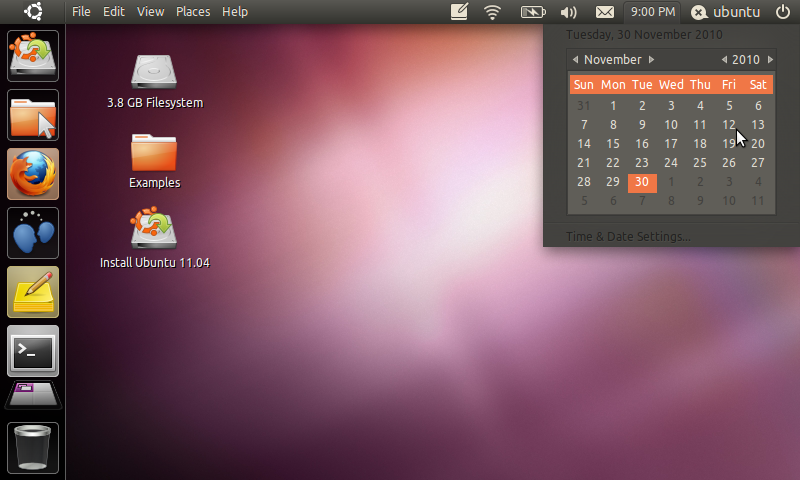
My favourite indicator is back – Indicator-Datetime! I’ve absolutely no logical/sane reason as to why I love it so much but it’s there, rocking out with its calendar widget…
Screenshot-4
Panel applets
I suppose the biggest change most users would recoil in horror at when using the Alpha is the redaction of traditional panel applets; applications using the old system tray are now at a loss.
Which means that…
Network Manager
The Network Manager applet now wears ‘indicator’ clothes. It feels feeble to say that this makes a huge difference to the way the desktop ‘feels’ but it really does.
Screenshot-2

Obligatory Video of Alpha 1 in action

Download

If you’re feeling brave you can grab Natty Alpha 1 – as well as see a comfortingly long list of known issues – @ ubuntu.com/testing/natty/alpha1

The end of Ubuntu Netbook edition

Canonical has announced that ‘Ubuntu Netbook Edition’ – the netbook-orientated version of the Ubuntu operating system – will be ‘folded’ into ‘Ubuntu Desktop Edition’ for Ubuntu 11.04, with the latter being rebranded simple as ‘Ubuntu’.
Canonical marketing manager Gerry Carr writes: -
“From 11.04 the core product that you run on your PC will be simply, Ubuntu. Therefore the next release will be Ubuntu 11.04 and you can run that, my friend, on anything you like from a netbook to a notebook to a desktop. “


So why the move?

Unlike previous editions of the operating system Ubuntu 11.04 comes with Unity as the default desktop ‘shell’. As Unity was created, originally, for Ubuntu Netbook Edition, but now adapted for use as a desktop interface, Ubuntu 11.04 is able to work just as well on a netbook screen as on a desktop.
‘Two birds, one stone’ and all that.
Carr highlights that the move should certainly not been seen as  a ‘withdrawal’ from catering towards netbook users, saying that the move is the result of Canonical ‘recognising that the market has moved on’ and that ‘separate images are no longer a requirement as the much anticipated convergence of devices moves closer. “
The move does not affect Ubuntu Server Edition.

What is Android?

Developed by the Open Handset Alliance, Android brings Internet-style innovation and openness to mobile phones.
Android™ delivers a complete set of software for mobile devices: an operating system, middleware and key mobile applications. The Android Software Development Kit (SDK) is now available.

Open

Android was built from the ground-up to enable developers to create compelling mobile applications that take full advantage of all a handset has to offer. It was built to be truly open. For example, an application can call upon any of the phone's core functionality such as making calls, sending text messages, or using the camera, allowing developers to create richer and more cohesive experiences for users. Android is built on the open Linux Kernel. Furthermore, it utilizes a custom virtual machine that was designed to optimize memory and hardware resources in a mobile environment. Android is open source; it can be liberally extended to incorporate new cutting edge technologies as they emerge. The platform will continue to evolve as the developer community works together to build innovative mobile applications.

All applications are created equal

Android does not differentiate between the phone's core applications and third-party applications. They can all be built to have equal access to a phone's capabilities providing users with a broad spectrum of applications and services. With devices built on the Android Platform, users are able to fully tailor the phone to their interests. They can swap out the phone's homescreen, the style of the dialer, or any of the applications. They can even instruct their phones to use their favorite photo viewing application to handle the viewing of all photos.

Breaking down application boundaries

Android breaks down the barriers to building new and innovative applications. For example, a developer can combine information from the web with data on an individual's mobile phone -- such as the user's contacts, calendar, or geographic location -- to provide a more relevant user experience. With Android, a developer can build an application that enables users to view the location of their friends and be alerted when they are in the vicinity giving them a chance to connect.

Fast & easy application development

Android provides access to a wide range of useful libraries and tools that can be used to build rich applications. For example, Android enables developers to obtain the location of the device, and allows devices to communicate with one another enabling rich peer-to-peer social applications. In addition, Android includes a full set of tools that have been built from the ground up alongside the platform providing developers with high productivity and deep insight into their applications.

Sunday, February 20, 2011

Groklaw: How One Person Can Do Big Deeds

The endless SCO saga is finally at an end, and justice has prevailed. But without Groklaw, would it have ended differently? Let me rephrase that: it will probably continue to sputter and emit random gases, because the nice SCO leadership and their backers are masters of weaving grand propositions out of fantasy, and perpetuating their fantasies in the seemingly non-functional US civil courts system. But for all non-Bizarro world purposes it is over. The SCO vs. Novell verdict settles the key question of who owns the Unix copyrights. Answer: not SCO. I know, it's a little more complex than that because there are several Unix variants. But as far as SCO's silly claims against Linux, it is definitively over.
Those of us who followed this loony saga from the beginning are wondering: What would have happened if Pamela Jones and Groklaw had not taken an interest in this case? Would there have been any semblance of truth anywhere? I think not.
Cast your minds back to the beginning in 2003, when Groklaw was a few months old, and had moved from Radio UserLand to its current home on Ibiblio.org. Darl McBride was shooting off his mouth to anyone who would listen, spouting the craziest nonsense. The SCO Group were making novel claims like IBM was devaluing their business by stealing SCO's Unix code and infiltrating it into Linux, which transformed Linux from an inferior hobbyist's toy into an enterprise powerhouse that stole SCO's business. It was unusually entertaining for business litigation: this unknown pipsqueak taking on Big Blue, a crazy braggart CEO who was always good for fun sound bites, the SCO Information Minister Blake Stowell emitting equally nonsensical comments with a straight face, and escalating legal claims against AutoZone, DaimlerChrysler, and Novell. When media interest waned he re-gained center stage with stunts like hiring celebrity loser lawyer David Boies, and claiming that crazy Linux fanatics threatened his life so he had to hire a bodyguard.
Fueling the fun was both the mainstream and tech press dutifully reporting all of it, without bothering to question any of CEO McBride's claims or do any independent investigation. And then there were the fine "independent" industry "analysts" and "reporters" (yes, my fine readers, those quote marks indicate sarcasm) like Laura DiDio of the Yankee Group, Dan Lyons of Forbes magazine, and Rob Enderle and Maureen O'Gara of anyone who would publish them, who wrote thousands of words solemnly assuring their readers that SCO's claims were solid, and boy were those unwashed Linux hippies going to be sorry they stole all that stuff from SCO.
The deck was completely stacked against any kind of real reporting from the beginning. Would this have mattered in the courtroom? After all, SCO was taking on companies many times larger, and who had the deep pockets to fund all the legal firepower they needed. So I can't say what effect Groklaw might have had in the courtroom, if any.
But Groklaw had a huge effect on getting the truth out, informing and energizing people who were following the case. PJ dug through the mounds of manure and obfuscation and uncovered what was really going on. She analyzed and posted reams of court filings, challenged Darl's ridiculous claims (which should have aroused skepticism in anyone with an ounce of sense), and inspired hordes of volunteers to attend court sessions, transcribe grotty PDF transcripts, and do additional research. She preserved archives of SCO's own online documents which later disappeared, or were changed. She also inspired a number of journalists to go beyond the sound bites and do some digging of their own. Groklaw awakened an interest in the law in a lot of its followers, and gave a fascinating inside look into how the law works.
She did all this despite ongoing harassment and threats. That takes bravery, and not many people would have persisted. Thank you PJ, what you have achieved with Groklaw is a very big deal. We owe you a lot.

HTML5 will henceforth be known as just HTML

HTML5 is the next major version of HTML and is widely considered future of the Web. In particular, HTML5 adds many new syntax features. These include <video>, <audio> and <canvas> elements as well as integration of SVG content, which are designed to improve the inclusion and handling of multimedia and graphic content on the web without recourse to proprietary plugins and their APIs [Source : Wikipedia].

The Web Hypertext Application Technology Working Group (WHATWG) is a community founded by individuals of Apple, the Mozilla Foundation, and Opera Software in 2004. It's main focus is the development of HTML standard and APIs needed for Web applications.

In a blog post, WHATWG has announced that HTML5 is going to lose its version number. HTML5 can now be considered as a "living standard", and will henceforth be known as HTML, with the URL http://whatwg.org/html.

On an unrelated note, W3C unveiled a new HTML5 logo to help the developers and website builders promote the HTML5 standard by letting the world know that they are using HTML5.


HTML5 Logo
If you are wondering, the HTML5 logo (shown above) signifies "a coat of arms and badge of honor".

They are also selling T-shirts,and mugs and a part of the proceeds will support the HTML5 test suite effort.

HTML5 Sticker

Here is what the W3C blog had to say about the purpose of this logo (and I quote).

We intend for it to be an all-purpose banner for HTML5, CSS, SVG, WOFF, and other technologies that constitute an open web platform. The logo does not have a specific meaning; it is not meant to imply conformance or validity, for example. The logo represents "the Web platform" in a very general sense.

The logo is available under a permissive license (Creative Commons 3.0 By) so that you can make it fit into your own designs.

Is Nokia Committing Harakiri By Aligning With Microsoft ?

Nokia Cell Phones
The big news today - as far as cellular world should be concerned, is the strategic partnership between Nokia and Microsoft to produce smart phones running Windows 7. Nokia says it will adopt Windows Phone as its primary smart phone strategy. Meaning, Symbian OS is going to be relegated to history. And MeeGo project on Nokia smart phones would be in limbo.


Thinking back, my first cell phone was a Nokia. At that time, Nokia was a dominant player in the Indian cell phone market. However, in the years that followed, Samsung and many other players have succeeded in grabbing a share of the pie (obviously at Nokia's expense).

So much so that, in India at present, if you go to any mobile shop to buy a cell phone, chances are you will be deluged with Samsung devices and not Nokia's. Currently, even I use a Samsung cell phone (though not a smart one). Verily Samsung offers more variety to its customers than Nokia ever has.

In the future, it is a given that mobile devices are going to permeate our lives even more. And smart phones are going to replace their dumb counterparts. Be that as it may, one of the best ways for Nokia to reclaim its market share is through innovation - by rolling out smart phones powered by its own homegrown OS. MeeGo, which is being developed on a Linux kernel shows a lot of promise. For one, there won't be a dearth of applications on MeeGo as most applications that run on Linux will run on MeeGo as well.

Sleeping with Microsoft is not going to turn Nokia's fortunes for the better any more than if it were to embrace an open source OS to power its smart phones.

For instance,
  • Windows OS is closed source and proprietary.
  • It entails paying a royalty to Microsoft. And that additional cost will be transferred to the customer. 
  • Nokia will be subjugated to play a lesser role in the smart phone arena - the terms being dictated by Microsoft.
  • And Nokia risks alienating its customers who might move to embrace products from its competitors which are powered by an open source OS.

Not surprisingly, this official announcement by Nokia and Microsoft has invited widespread criticism as indicated by over 460 comments made there.

On a personal level, I was looking forward to buying a MeeGo powered Nokia cell phone when it was released. I guess my wait is going to be futile.

Monday, February 14, 2011

Microsoft releases near-final Internet Explorer 9 version

IE9 is a free download that works Windows Vista and Windows 7 computers. It's not compatible with Windows XP.
With , followed the visual lead of Google Inc.'s Chrome browser. IE9 has far fewer buttons, icons and toolbars filling the screen, leaving more room for the contents of Web pages. It mimics some features in Windows 7, the newest PC from Microsoft, in that it lets people "pin" individual websites to the taskbar at the bottom of the PC screen to make permanent one-click shortcuts.
Based on feedback from the , which Microsoft said was used by 25 million people, the software will let people add a new row of tabs to the bar at the top of the browser window. It will also pop up fewer notifications.
The new browser is much more than an aesthetic overhaul. IE9 can take advantage of multicore microprocessors to crunch website code faster. It also uses the PC's - the same chips that make the images in elaborate video games run smoothly - to make movie clips and other visuals load and play faster.
Microsoft said Thursday that it has improved several aspects of the browser that make it run faster than the beta that was released in September. It fine-tuned the engine for rendering JavaScript, a widely used Web programming language, so pages load faster. IE9 now also decides on the fly when to tap into the graphics processor for more speed.
Competitors including Google and Mozilla, maker of the Firefox browser, are also working on similar technical upgrades to their software. This new crop of browsers will be competing with "apps," small programs for smart phones, tablets and other devices that deliver the some of the same content as websites but in a way that's easier to navigate on smaller screens.